It is a kind of magic you can pull off as a group.
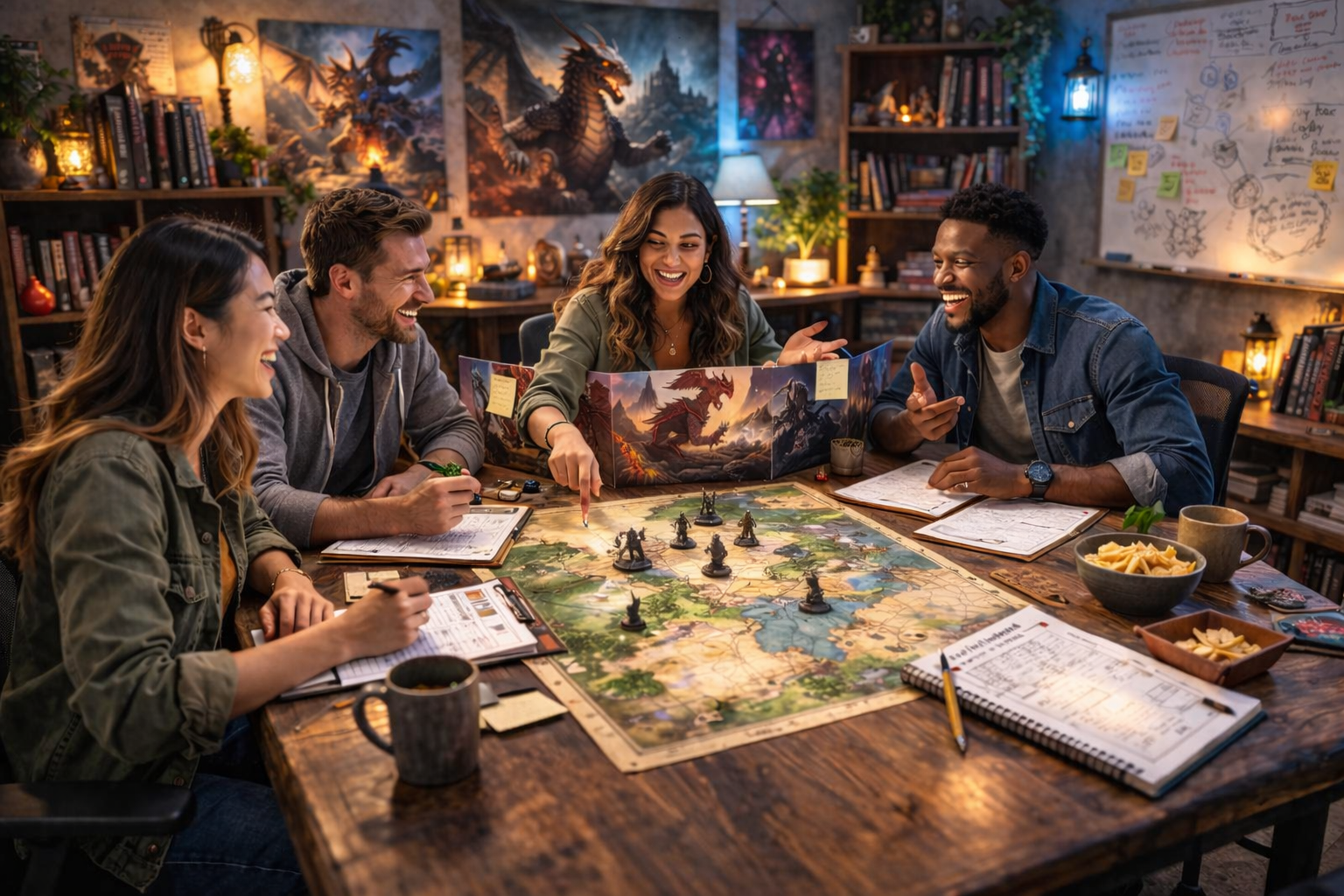
There’s a particular kind of magic that happens when a group gathers around a table, character sheets in hand, dice ready to roll. A map lies open. A Dungeon Master smiles knowingly behind a screen. And in that moment, the ordinary world fades—replaced by dragons, daring rescues, moral dilemmas, and impossible choices.
But tabletop role-playing games (TTRPGs) are more than fantasy escapism.
They are training grounds for sharper minds, stronger bonds, and unforgettable shared memories.
Thinking as a Team
In a role-playing game, no one succeeds alone.
A warrior may be brave, but reckless without the strategist. A wizard may be brilliant, but vulnerable without protection. A rogue may be clever, but dependent on distraction to strike at the right moment. Every character has strengths—and weaknesses.
The same is true of the players.
TTRPGs naturally push groups to assess problems collaboratively. Faced with a locked gate, a suspicious noble, or an ambush in the forest, the table becomes a think tank. Players analyze risks, debate tactics, weigh consequences, and build plans that account for each member’s capabilities.
Over time, something powerful happens: players begin to recognize each other’s real-world strengths.
“Let her handle the negotiation.”
“He’s good at spotting loopholes.”
“Give him the map—he thinks spatially.”
Problem-solving becomes less about individual brilliance and more about collective intelligence.
Stories That Leave a Mark
Unlike most games, role-playing adventures create stories that belong entirely to the group. The narration, the actions, the consequences—they are shaped in real time by the players’ choices.
When the party chooses mercy instead of vengeance, that decision lingers.
When a character sacrifices themselves to save the group, the moment becomes legendary.
When a plan collapses spectacularly, the laughter echoes for years.
These moments become core memories.
They’re retold at dinners. Referenced in inside jokes. Remembered not just as gameplay, but as shared experience. In a world of disposable entertainment, TTRPGs create stories that feel earned and deeply personal.
Consequences That Build Character
Role-playing games gently teach a powerful lesson: choices matter.
Actions have consequences. Plans can fail. Trust can be broken—or strengthened. Because the stakes feel real within the narrative, players experience emotional investment in outcomes. They learn to think ahead, consider long-term impact, and reflect on their decisions.
It’s safe failure with meaningful lessons.
A misjudged alliance in a fantasy kingdom might spark discussion about trust and discernment. A poorly coordinated battle highlights the need for communication. A moral dilemma opens space to explore values.
Growth happens organically, wrapped in adventure.
Discovering Each Other Along the Way
Perhaps the most overlooked gift of tabletop role-playing games is what they reveal about the people at the table.
Who steps up under pressure?
Who prefers careful planning?
Who takes creative risks?
Who mediates conflict?
Through collaborative storytelling, personalities shine. Players learn how their friends think, react, lead, support, and empathize. The game becomes a mirror—sometimes revealing strengths the person didn’t even know they had.
In families, this can be transformative. In friendships, it deepens trust. In classrooms or teams, it builds understanding.
Adventure as a Forge
We often think that stronger minds are built in classrooms, through textbooks and tests. But they are also forged in moments of shared challenge—where ideas are tested, perspectives are broadened, and collaboration is essential.
Tabletop role-playing games offer exactly that.
They sharpen problem-solving skills.
They strengthen teamwork.
They create lasting memories.
They reveal character.
So gather your party. Set the scene. Roll the dice.
Because sometimes the greatest adventures don’t just change the story—they strengthen the minds telling it. 🎲✨